Accra, Ghana — Dr. Cassiel Ato Baah Forson, Ghana’s Minister for Finance, has confirmed the government’s commitment to ending the export of raw gold from Ghana as part of a broader effort to add value to the country’s natural resources and strengthen local refining capacity.
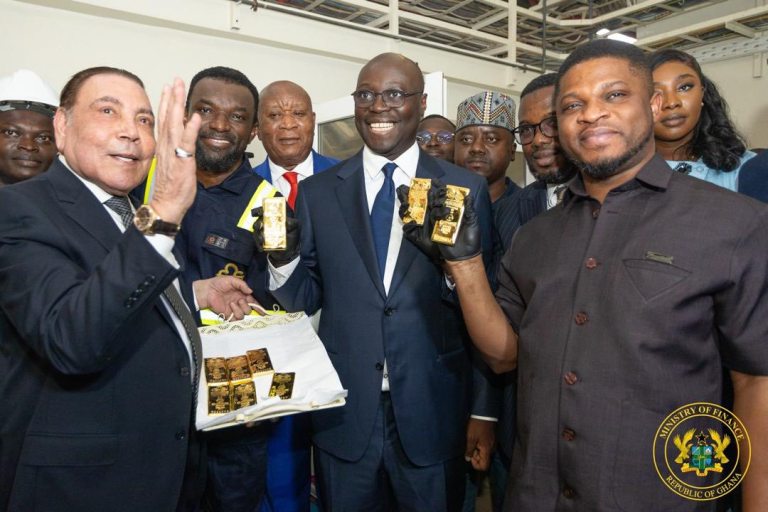
Speaking after an inspection of the Gold Coast Refinery, Dr. Forson described the facility as a “major step” toward Ghana’s industrialisation agenda, highlighting the shift from exporting unprocessed minerals to processing and refining within the country.
“The establishment of the Gold Coast Refinery reflects our long-standing national aspiration to move beyond the export of raw minerals,” the Finance Minister stated. While he did not provide an immediate cutoff date in comments released publicly, he affirmed that the government will soon end raw gold exports, which positions Ghana to keep more economic value and create jobs locally.
This announcement aligns with existing government policy aimed at promoting value addition in Ghana’s gold sector. Reports indicate that operations of the Gold Coast Refinery are being scaled up to boost domestic processing and reduce reliance on exporting semi-processed doré bars.
Context and Policy Rationale
Ghana, one of Africa’s largest gold producers, has historically exported large quantities of raw or semi-processed gold. However, policymakers have increasingly stressed the need to retain more value domestically by refining gold before export.
Recent reforms have included changes to the taxation and royalty regime for mining companies designed to extract greater revenue from gold production. In this context, the Finance Minister has also proposed adjustments to levies and royalty structures to balance investment interests with national revenue objectives.
Reuters
What This Means for the Gold Sector
Value Addition: Ending raw gold exports is expected to shift Ghana toward exporting refined bullion and finished products, potentially increasing earnings from global markets.
Industrial Growth: Expansion of domestic refining facilities like the Gold Coast Refinery supports job creation and technology transfer.
Foreign Exchange Retention: Keeping gold processing in Ghana may improve foreign exchange inflows and help stabilise the cedi.
Government officials have noted that the transition will involve continued engagement with industry stakeholders to ensure orderly implementation.

 Accra, Ghana — Dr. Cassiel Ato Baah Forson, Ghana’s Minister for Finance, has confirmed the government’s commitment to ending the export of raw gold from Ghana as part of a broader effort to add value to the country’s natural resources and strengthen local refining capacity.