
Security Agencies Can Arrest MPs Without My Permission — Speaker Bagbin Clarifies Constitutional Position
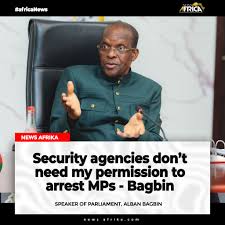
Speaker of Parliament, Alban Bagbin, has clarified that Ghana’s security agencies do not require his approval before arresting or inviting a Member of Parliament for questioning, stressing that their constitutional obligation is only to officially notify his office and provide details of the allegations involved.
The Speaker made the remarks on Thursday, May 21, 2026, during the opening sitting of the Second Meeting of the Second Session of the Ninth Parliament, amid increasing public debate over the powers of law enforcement agencies in dealing with lawmakers.
According to Mr. Bagbin, there is widespread misunderstanding among sections of the public and even within political circles that the Speaker must first authorize the arrest or investigation of MPs before any action can be taken by police or other security institutions. He explained that this interpretation is inaccurate under Ghana’s constitutional framework.
“It’s not for the security agents to seek my permission before arresting or inviting a member of parliament for questioning. It’s for them to inform me and include the circumstances or the allegations that have created the suspicion,” the Speaker stated during proceedings in Parliament.
Mr. Bagbin further explained that once Parliament is notified, his office may then determine whether parliamentary privileges or constitutional immunities apply in the matter. He emphasized that Members of Parliament are not above the law, but certain constitutional protections exist to ensure lawmakers can effectively perform their duties without unnecessary interference.
The Speaker’s clarification comes at a time of heightened national attention over the recent detention of the Member of Parliament for Asante Akyem North, Ohene Kwame Frimpong, in the Netherlands. The MP was reportedly arrested at Schiphol Airport on May 8, 2026, over alleged money laundering-related issues linked to an international warrant.
The incident generated widespread political and legal discussions in Ghana, with many questioning whether Parliament or the Speaker should have been formally consulted before such action was taken against a sitting MP. Analysts and political commentators also debated the scope of parliamentary immunity and whether lawmakers enjoy protection from arrest while serving in office.
Interestingly, Bagbin’s latest comments appear to mark a softer and more legally nuanced position compared to statements he made in 2021. At the time, the Speaker strongly warned security agencies against arresting or prosecuting MPs without notifying his office, insisting that Parliament would resist attempts to undermine the constitutional privileges of lawmakers.
In his 2021 remarks, Bagbin argued that parliamentary immunities were necessary to protect the democratic process and ensure MPs could participate fully in parliamentary business without intimidation or politically motivated arrests. He had cautioned that indiscriminate arrests of MPs during parliamentary sessions could disrupt governance and legislative work.
However, his latest clarification suggests a clearer distinction between “permission” and “notification,” emphasizing that while the Speaker must be informed, security agencies do not legally need parliamentary approval before acting. Legal observers believe the clarification is aimed at correcting public misconceptions and balancing parliamentary independence with the rule of law.
Beyond the constitutional clarification, the Speaker also urged lawmakers from both the Majority and Minority sides to conduct parliamentary debates with discipline, mutual respect, and civility as Parliament resumes sitting with a heavy legislative workload.
Mr. Bagbin noted that several critical national bills and policy issues are expected to dominate the current parliamentary meeting, including governance reforms, justice sector matters, and debates surrounding the controversial Human Sexual Rights and Family Values Bill.
Security Agencies Can Arrest MPs Without My Permission — Speaker Bagbin Clarifies Constitutional Position






Leave a Reply