
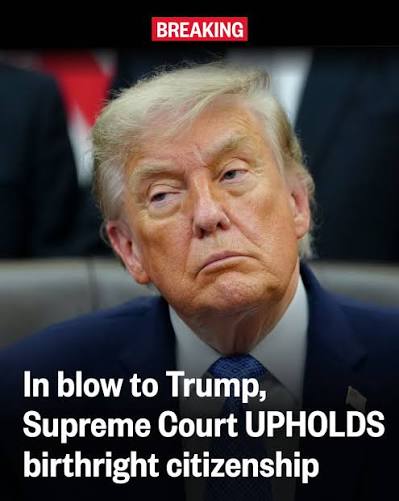
BREAKING: U.S. Supreme Court Delivers Historic Blow to Trump, Strikes Down Executive Order to End Birthright Citizenship
In a landmark constitutional ruling, the U.S. Supreme Court has struck down President Donald Trump’s executive order seeking to end automatic birthright citizenship, reaffirming that the U.S. Constitution guarantees citizenship to nearly everyone born on American soil, regardless of their parents’ immigration status. Donald Trump Supreme Court of the United States
The decision represents one of the most significant constitutional defeats of Trump’s second presidency and preserves a legal principle that has defined American citizenship for more than 150 years. In a 6-3 ruling, the Court held that the president cannot override the Constitution through an executive order, reaffirming that the Citizenship Clause of the 14th Amendment protects children born in the United States, except in very limited circumstances such as children of foreign diplomats.
Background
Shortly after returning to office in 2025, President Trump signed Executive Order 14160, directing federal agencies to deny automatic U.S. citizenship to children born in the country if neither parent was a U.S. citizen or lawful permanent resident. The administration argued that the Constitution’s phrase “subject to the jurisdiction thereof” did not extend to people living in the United States unlawfully or temporarily.
The order immediately triggered multiple lawsuits from civil rights organizations, several U.S. states, immigrant advocacy groups and affected families. Federal judges across the country blocked the order from taking effect, finding that it likely violated the Constitution and long-established Supreme Court precedent.
The Supreme Court’s Reasoning
Writing for the majority, Chief Justice John Roberts concluded that the Constitution’s text, history and longstanding legal precedent overwhelmingly support birthright citizenship. The Court relied heavily on the 14th Amendment, adopted in 1868 after the Civil War, as well as the landmark 1898 decision in United States v. Wong Kim Ark, which established that nearly everyone born on U.S. soil is automatically an American citizen. John Roberts United States v. Wong Kim Ark
The majority ruled that a president cannot rewrite the Constitution through executive action and that any attempt to fundamentally change citizenship rights would require constitutional or legislative action consistent with constitutional limits.
Three conservative justices dissented, arguing that the Constitution should be interpreted more narrowly regarding who is “subject to the jurisdiction” of the United States. However, their position did not command a majority, leaving the existing constitutional interpretation firmly in place.
Following the ruling, President Trump criticized the decision and called on Congress to pursue legislation aimed at ending birthright citizenship, insisting that lawmakers should continue efforts to change U.S. citizenship policy despite the Court’s judgment. Legal scholars, however, note that altering a constitutional guarantee would face enormous legal and constitutional hurdles.
Why the Decision Matters
The ruling is expected to affect hundreds of thousands of children born in the United States each year and reinforces one of the nation’s oldest constitutional protections. It is also viewed as a major affirmation of judicial independence and constitutional limits on presidential authority.
Legal experts describe the judgment as one of the most consequential immigration rulings in recent U.S. history, ensuring that birthright citizenship remains protected under the Constitution unless changed through the constitutional amendment process or other constitutionally valid means.










Leave a Reply