
Ghana and Netherlands Forge Stronger Alliance to Crush Illicit Drug Networks and Criminal Money
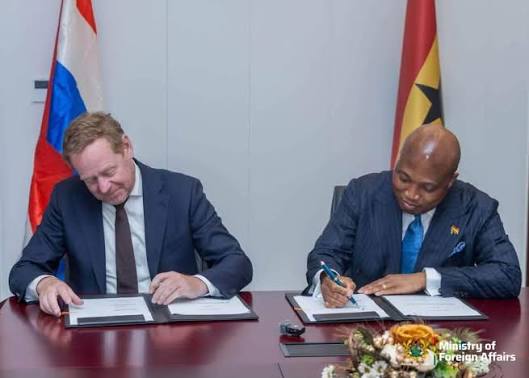
Ghana and the Netherlands have strengthened their partnership in the fight against illicit drugs, organised crime and the criminal networks financing the illegal drug trade, following the signing of a special Letter of Intent between the two countries.
The agreement is expected to deepen cooperation between Ghanaian and Dutch authorities in tackling the growing threat posed by cocaine trafficking, synthetic drugs, illicit financial flows and other forms of transnational organised crime.
Ghana’s Minister for Foreign Affairs, Samuel Okudzeto Ablakwa, signed the Letter of Intent on behalf of Ghana, while the Netherlands’ Minister for Justice and Security, David Van Weel, signed for the Dutch government during his official visit to Ghana. The agreement forms part of efforts by both countries to establish stronger and more structured cooperation against criminal networks operating across national borders.
Agreement builds on Accra Call to Action
The new cooperation builds on the Accra Call to Action on Drug Markets in West Africa, which was adopted following a high-level dialogue held in Accra in November 2025.
The dialogue brought together Ghana, the Netherlands and representatives from several West African countries to examine the rapidly changing drug landscape in the region, particularly the growing trafficking of cocaine and synthetic drugs.
The Accra Call to Action emphasised the need for stronger international cooperation, intelligence sharing, early-warning systems, evidence-based prevention and treatment, and coordinated action against transnational drug networks.
The latest Ghana-Netherlands agreement therefore represents an effort to move those commitments from dialogue into more concrete bilateral cooperation.
Focus on criminal networks and drug money
The partnership goes beyond the seizure of narcotics.
Ghana and the Netherlands are also concerned about the financial structures that sustain the illicit drug trade. Criminal organisations generate enormous revenues from drug trafficking and often attempt to conceal or move those proceeds through legitimate businesses, financial transactions and international networks.
The two countries have therefore identified organised crime, money laundering and illicit financial flows as important areas for stronger cooperation. Efforts to trace, freeze and recover criminal proceeds are expected to form part of the broader response to the drug trade.
Growing threat of cocaine and synthetic drugs
The agreement comes at a time when West Africa is facing an increasingly complex illicit drug market.
According to information presented during the 2025 Accra dialogue, the region has become an important transit corridor for cocaine moving between Latin America and Europe, while synthetic drugs are also becoming increasingly diverse and accessible.
The threat is particularly concerning because synthetic drug markets are evolving rapidly, with substances such as methamphetamine, synthetic cannabinoids and other new psychoactive substances presenting significant challenges to law enforcement and public-health authorities.
Ghanaian authorities have also warned that drug abuse, particularly among young people, has become a major national security and public-health concern.
Foreign Affairs Minister Samuel Okudzeto Ablakwa has stressed that illicit drugs are not only a law-enforcement problem but also a threat to young people, public health, the rule of law and human rights.
Netherlands strengthens support for Ghana’s border security
The partnership also builds on practical support that the Netherlands has provided to Ghana in strengthening its capacity to detect and intercept illicit goods.
The Netherlands has supported Ghana with advanced screening technology for use at the country’s points of entry, including equipment intended to improve the detection of narcotics and other prohibited items.
The Narcotics Control Commission (NACOC) has also announced plans to deploy new drug-detection scanners at Kotoka International Airport, with Ghana and the Netherlands collaborating on the replacement and enhancement of airport screening equipment.
Such measures are considered important because traffickers continue to exploit international airports, seaports and other transportation networks to move drugs across borders.
A wider international response
Ghana and the Netherlands’ latest commitment reflects a recognition that drug trafficking cannot be effectively tackled by individual countries acting alone.
Criminal organisations increasingly operate across multiple jurisdictions, with different groups responsible for production, transportation, distribution, money laundering and other stages of the illegal trade.
The Accra Call to Action therefore called for stronger information sharing, cooperation between law-enforcement agencies, customs and border authorities, improved early-warning systems and greater international collaboration.
For Ghana, the strengthened relationship with the Netherlands could provide additional opportunities for intelligence-led operations, technical assistance and cooperation with European law-enforcement authorities.
Protecting Ghana’s youth
Beyond enforcement, both countries have acknowledged the need for prevention, treatment and rehabilitation.
The Accra Call to Action specifically highlights the importance of protecting young people, reducing drug-related harm and expanding evidence-based prevention, treatment and reintegration programmes.
This means that the fight against illicit drugs is expected to involve not only police, customs and security agencies but also public-health institutions, communities, civil society organisations and other stakeholders.
Ghana-Netherlands partnership enters a new phase
The signing of the Letter of Intent marks another step in the growing security relationship between Ghana and the Netherlands.
Both countries have expressed concern about the increasingly international nature of drug trafficking, organised crime and illicit financial flows and have indicated an interest in developing a more permanent and structured mechanism for bilateral cooperation.
With Ghana serving as an important link between West Africa and international trade routes, and the Netherlands occupying a major position within European logistics and transport networks, cooperation between the two countries could play a significant role in disrupting criminal supply chains.
The success of the agreement, however, will ultimately depend on how effectively the commitments are translated into intelligence sharing, coordinated investigations, stronger border controls, financial investigations and measures to prevent drug-related harm.
For Ghana and the Netherlands, the message is clear: the fight against illicit drugs must extend beyond individual seizures to the dismantling of the criminal networks and financial systems that keep the trade alive.






Leave a Reply